Pressure Controller vs Pressure Switch on a Booster Pump
Every booster pump needs something that tells it when to run. On household pumps that is usually a pressure switch with a tank, or an electronic pressure controller.
A booster pump should run when you open a tap and stop when you close it. Something has to make that decision. On most household booster pumps, that job falls to either a pressure switch, usually working with a small pressure tank, or an electronic pressure controller. Knowing which one you have helps explain how your pump behaves, and helps us understand your setup from photos.
The pressure switch: the classic setup
How it works
A pressure switch is a small box, often with a grey or black cover, mounted on the pipe near the pump. Inside are electrical contacts and a spring. When pressure in the pipe falls below a set point, the contacts close and the pump starts. When pressure rises to an upper set point, the contacts open and the pump stops.
Why it usually comes with a tank
A pressure switch works best with a small pressure tank beside it, the round or bottle-shaped vessel you sometimes see next to the pump. The tank stores a little water under pressure, so small draws such as a quick hand wash can be served without starting the pump every time. Without a working tank, the pump may switch on and off rapidly.
What you might notice
- Pressure rises and falls slightly as the pump cuts in and out.
- The pump starts briefly even for a small draw if the tank has lost its air charge.
- A clicking sound from the switch box each time the pump starts or stops.
The pressure controller: the electronic option
How it works
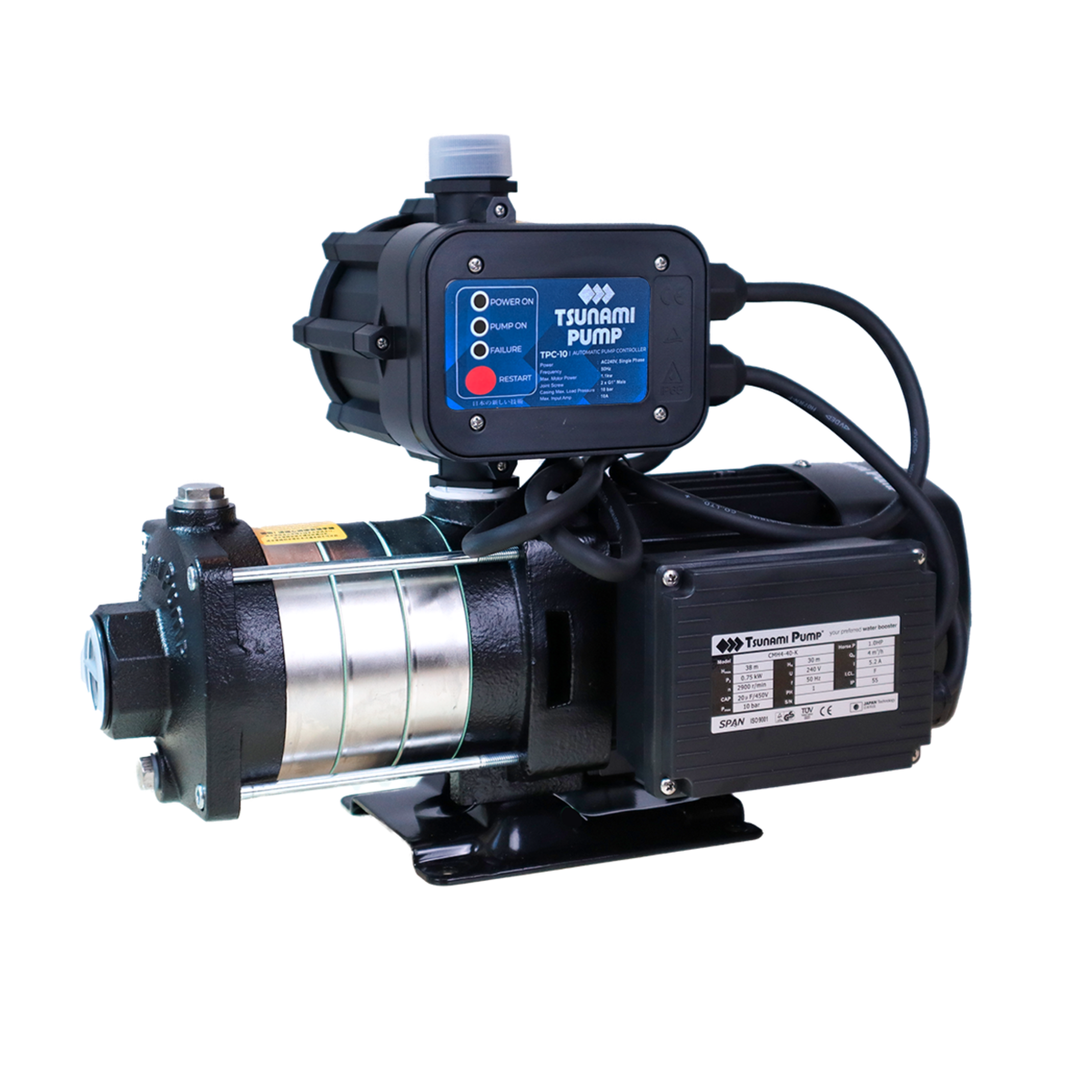
A pressure controller, sometimes called an automatic pressure control or flow controller, is usually a compact unit fitted right at the pump outlet, often with a small built-in gauge and indicator lights. It starts the pump when pressure drops as you open a tap, and stops it once flow stops. Many controllers can also stop the pump if it runs without water, but features differ by unit, so check the label or manual of the one you have.
Why many households like it
Because the controller responds to flow, the pump keeps running for as long as a tap is open, which tends to give a steadier shower than a switch cycling on and off. It is also compact, as there is usually no separate tank on the side.
What you might notice
- The pump starts as soon as a tap is opened and stops shortly after it is closed.
- Indicator lights show power, running or a fault state.
- A dripping tap or small leak can make the pump start now and then.
Which one does your pump have?
What to photograph
- The whole pump from the side, including what is fitted on its outlet.
- Any box, gauge or unit with lights on the pipe next to the pump.
- Any round or bottle-shaped tank nearby.
- The labels on the pump and on the controller or switch.
- A short video of the pump starting and stopping when a tap is opened and closed.
When something seems wrong
If the pump keeps cycling, will not start or runs without stopping, the cause could be the switch, the controller, the tank, a leak or the pump itself. Repair and diagnosis are quoted after we see photos and a video, because guessing from a description alone is unreliable.
A note on safety
Pressure switches and controllers carry mains power. Look and photograph, but leave opening covers or adjusting set points to someone qualified.
Choosing a new booster pump
Packages and what they include
Our supply and install packages cover Tsunami at RM1,800 (0.50HP), RM2,000 (0.75HP) and RM2,200 (1.00HP), and the premium Grundfos option at RM3,600 (0.50HP), RM3,800 (0.75HP) and RM4,000 (1.00HP). Each includes the pump unit, professional installation, basic wiring, and pressure and function testing. See the details on our booster pump packages. Installation only, for your own pump, is RM800.
Send us your photos
Whether you are in a terrace in Seremban, a link house in Kajang or an older home in Ipoh, the photos above tell us a lot. Send the address with them and we will tell you if a visit can be arranged. WhatsApp us now